
How much should you spend on brand vs performance?

Mar 25, 2026
By Mark Noakes
Most marketing conversations seem to still start with the same question: what channel should we spend on?
The better question is: what are you trying to achieve?
Because most businesses are juggling two very different pressures:
- Short-term revenue targets
- Long-term growth ambition
And the conflict between these is where the brand vs performance debate shows up.
The real problem isn’t budget (it’s understanding)
Businesses don’t underinvest in brand because they don’t care. They underinvest because they don’t understand how it works.
Performance is measurable, immediate and comforting. You can see leads. You can see revenue. You can optimise it next week. Brand feels slower. Less direct. Harder to justify in a boardroom.
So it gets framed as a choice: we either invest in brand or we spend the money on performance.
But that framing misses the point. Brand isn’t an alternative to performance, it’s shaping the conditions performance operates in, whether you’re measuring it properly or not.
The 60/40 principle
One of the clearest ways to understand the role brand plays comes from the work of Les Binet and Peter Field. After analysing hundreds of campaigns, they found that the most effective growth strategies tend to balance investment over time, roughly 60% towards long-term brand building and 40% towards short-term sales activation.
That split is often misunderstood. It isn’t a rule about channels, creative formats, or how every business should allocate budget. And it’s not something you apply mechanically. What it reflects is the different jobs each type of activity is doing.
- Short-term activity is designed to capture demand that already exists.
- Long-term brand activity is what creates and refreshes that demand in the first place.
When too much weight sits on activation, you end up competing harder for a shrinking pool of attention. When brand is doing its job, performance has more to work with and less resistance to overcome.
That balance reflects the different jobs brand and performance do over time.
Not investing in brand is more expensive than you think
When brand is underinvested, the cost doesn’t show up all at once. It shows up in how hard performance has to work to keep things moving.
Without brand building demand in the background, you’re usually dealing with:
- A smaller pool of people actively considering you
- Lower conversion rates as buyers hesitate or default to familiar names
- Rising CPAs, even when performance execution is solid
Instead of capturing existing demand, brand is forced to introduce you, explain you, and convince people, all at the same time. And boy are you going to pay for that. Every. Single. Click.
This is where brand does its work, reducing the cost and effort required for performance to deliver over time.
Brand doesn’t replace performance. It makes it more efficient.
“But we’re not a big brand”
We get it.
If you’re early-stage or still proving your model, leaning heavily into performance makes sense. You still need cash flow and validation that things are working.
The issue is staying in that mode for too long.
As the business grows, performance-only strategies start to plateau. You’re paying more to reach the same people and pushing harder for smaller gains.
Brand is what unlocks the next phase, expanding the pool of people who recognise, trust, and choose your business.
What “brand spend” actually looks like in practice
Like we said, it’s not all billboards and big campaigns. In reality, brand awareness marketing just means:
- A clear creative platform that stays stable over time
- Distinctive brand cues people can recognise quickly
- Top-of-funnel activity designed to build familiarity, not force action
- Repetition and reach, rather than constant reinvention
This is where brand strategy matters. Without it, brand activity becomes fragmented with different messages, different signals, and different priorities. A clear brand strategy gives structure to those investments, ensuring everything is reinforcing the same idea over time.
If the work helps customers recognise you, remember you, or feel more comfortable choosing you later, it counts.
So, boldly go and review your budget today
Do you need to invest in brand right now? Ask yourself:
- Are CPAs rising despite technically “good” performance work?
- Does every campaign feel like it has to start from zero?
- Do people recognise your logo but not what you stand for?
- Are you constantly chasing efficiency instead of building leverage?
If so, it’s not a performance problem. It’s a brand problem. So, yes.
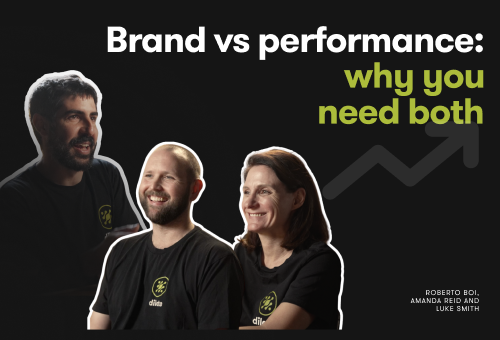
Brand builds the conditions for performance to work better. Performance turns that advantage into revenue. One without the other eventually caps growth.
The question isn’t how much should you spend on brand?
It’s how long do you want to keep paying more for the same results?