
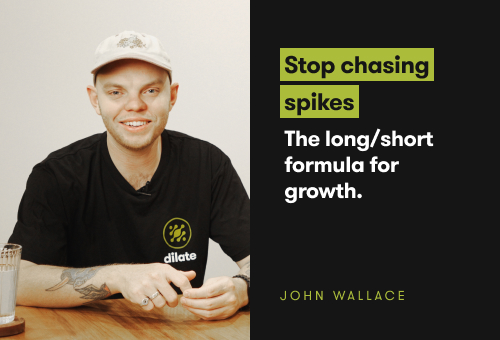

Stop chasing spikes: The long/short formula for growth

Jan 06, 2026
By John Wallace
Short-term tactics only take you so far. They deliver quick wins, then the curve flattens - CPAs go up, audiences shrink and optimisation becomes an expensive guessing game. Performance was never designed to carry the whole load.
If you’re leaning on activation to fill the gaps left by brand, you’re running a half-finished system. One that can move quickly, but not for long.
Brand builds future demand
Performance captures existing demand
And once you understand that, something becomes obvious.
Proper marketing doesn’t start with a “30% off” Black Friday ad
Only a small percentage of buyers already in-market - roughly 5–10% at any given time. There’s undeniable, pretty much unavoidable, evidence of that. Les Binet & Peter Field’s analysis of the IPA Databank (covering thousands of campaigns over decades) is a pretty good starting point.
Once that pool is saturated, costs rise, returns decline and performance plateaus. That’s the natural limit of short-term activation.
The long-term solves a different problem. Long-term brand building increases mental availability, salience and preference, expanding the number of people who will consider you in the future. This is reinforced by Ehrenberg-Bass and decades of IPA effectiveness data.
Put simply, this is the long and the short in action:
The short converts the few who are ready now; the long increases the many who’ll be ready later.
That’s why proper marketing isn’t judged by a single outcome. It operates on two time horizons: the work that moves today’s numbers and the work that makes future sales easier.
Sustainable growth happens when both sides are maintained, not when one is expected to do the job of the other.
Two sides of the coin
Les Binet and Peter Field’s analysis found that the strongest performing brands manage both time horizons deliberately, often investing more in the long-term than the short (usually around a 60/40 split, with variation by category).
So what does each side actually do?
Short-term: Performance / sales activation
Short-term activity is about capturing the small group of people who are already in-market - the ones actively searching, comparing or ready to make a decision.
- Goal: convert existing demand into revenue.
- Channels: search ads, direct response social, promotions, retargeting.
- Measures: CPL, CPA, ROAS - the familiar metrics with fast feedback loops.
- Effect: quick spikes that fade just as quickly.
If you launch a fantastic discount on Black Friday and run a bunch of ads, will it work? Yeah, probably.
Short-term activation is incredibly effective at generating immediate sales, but its impact decays rapidly. It’s harvesting. And harvesting only works when you’ve planted something to begin with.
Long-term: Brand building
Long-term activity focuses on shaping memory, meaning and preference among people before they need you, so that when they do start showing the need to buy, your name shows up first.
- Goal: create future demand by building mental availability and brand salience.
- Channels: anywhere you can tell a fluent, distinctive story to broad audiences - video, social, display, outdoor, audio, whatever fits the strategy.
- Measures: branded search uplift, direct traffic, higher conversion rates, easier sales conversations.
- Effect: slower build, broader reach, compounding commercial impact.
This is where the insights from Ehrenberg-Bass is especially relevant; brands grow by being easily thought of in buying situations and by building strong, distinctive memory structures over time.
And this is exactly where a clear brand strategy becomes essential - knowing what you want to be known for, the associations you need to strengthen, and the creative assets that make you recognisable at a glance.
Long-term brand building is how you plant the seeds that performance can later harvest.
The balance is everything
Short-term activation and long-term brand building do very different jobs, and leaning too heavily on one side creates predictable problems. Growth only compounds when both are working in sync.
If you focus on the now, you run into the same problems every performance-heavy business faces:
- Costs climb as bids increase.
- Competitors copy your tactics.
- You fight over the same small pool of “ready now” buyers.
- Audiences get tired of seeing the same ads.
- Improvements become incremental at best.
But, long-term brand building won’t move the numbers on its own. You still need the systems that turn interest into action: search, landing pages, offers, demos, sales teams.
Together = sustained, profitable growth
When the long and the short work together, marketing becomes both simpler and more effective. Brand does the heavy lifting over time, building memory, meaning and recognition across broad audiences through consistent storytelling, emotional ideas and distinctive assets. Performance then steps in at the moment of intent with focused tactics: high-intent search, offer-led retargeting, sharp landing pages and direct CTAs.
One creates tomorrow’s customers, whilst the other captures today’s.
Or put simply, performance drives the next month and your brand drives the next 12-36 months.
Why do we get suckered in by short-term wins so often?
Short-term metrics are addictive. CPA, CPL, ROAS all give us fast validation and the illusion of control. And because early Facebook/Google made everything look cheap and easy, most businesses got trained to chase the hit instead of building the engine.
You can spot the short-term mindset a mile away:
- constant discounting
- creative changing every week
- everything looking like direct response
- no emotional story
- rising CPAs despite “optimisation”
If that feels familiar, you’re not broken. You’re just running the same short-term loop as everyone else.
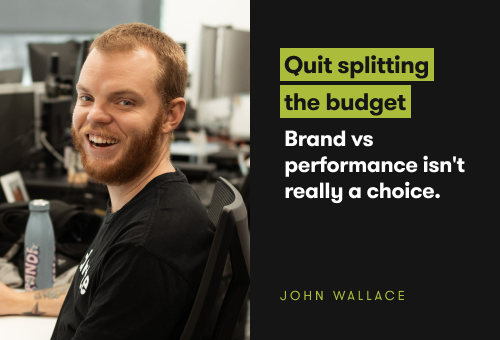
The real question isn’t “brand or performance?”
The real question is: how well are your long and short working together?
Too much short-term work exhausts the small group of people ready to buy now. Too much brand work creates interest without giving people a clear next step.
The businesses that grow steadily aren’t choosing a side. They’re making sure both pieces support each other, day after day. Brand vs performance isn’t even up for debate.
That’s the difference between marketing that spikes and marketing that actually scales.