
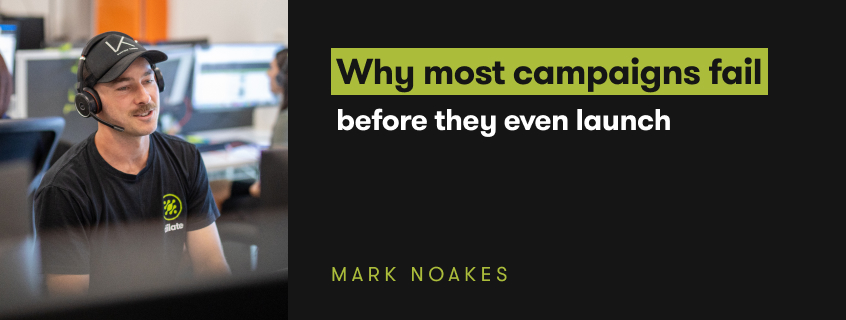
Why most campaigns fail before they even launch

Jan 22, 2026
By Mark Noakes
If you’ve ever launched a campaign that should have worked-solid creative, proven channels, a sensible budget-but didn’t, the problem usually isn’t where you’re looking.
Most businesses assume the problem sits in execution. The ads need tweaking. The copy needs sharpening. The platform has changed again. Something must be wrong in-market.
But campaigns rarely fail at the point they go live.
They fail earlier.
Not because the creative was bad, or because a platform changed, but because the thinking that happened beforehand was wrong. Often shaped by assumptions, preferences, and decisions that were never consciously made.
Campaigns are the output of earlier decisions. How the brand is positioned, who it’s for, what problem it’s solving, and what choices were or weren’t made during strategy. By the time a campaign goes live, much of the outcome is already locked in.
What follows is the sequence of upstream failures that quietly undermine campaigns long before performance metrics ever come into play.
The first big mistake: Not having a brand strategy
Most campaigns start with a marketing plan. But if that doesn’t stem from a brand strategy (not a brand guide, an actual brand plan), then every campaign that follows inherits that critical misunderstanding.
Most businesses treat brand strategy as a form of self-definition. What they want to say. How they look. The story they like. The tone that feels right. Often, the aesthetic the founder prefers.
This is usually where things start to unravel.
Brand is built in memory, not intention
In reality, brand strategy defines how the business should exist in the mind of the customer.
It determines:
- the mental associations the brand needs to build
- how the brand should be remembered when it’s not present
- which customers matter most right now
- how the brand is positioned relative to alternatives
- the distinctive assets campaigns will reinforce over time
- the role each campaign plays in long-term growth and short-term sales
This is the difference between brand as intent and brand as memory.
You can intend to be premium, trusted or innovative. But intent means nothing if those associations aren’t formed, reinforced and recalled. Brand strategy exists to deliberately shape memory, not to articulate aspiration.
You can’t build memory when you haven’t defined what memories you want to create.
Underinvesting in brand because you’re not thinking about the long game
Perhaps you know your brand strategy, but do you know how much it’s worth to you?
Brands underinvest in long-term brand building, then look to short-term campaigns to do more and more of the heavy lifting. For a while, that works. Then performance plateaus, and attention turns to what’s running in-market.
Most businesses expect performance marketing to carry the system. Activation is funded aggressively, immediate returns are demanded, and brand is treated as something to come back to later.
Performance doesn’t create demand
Short-term campaigns are effective at capturing demand. They were never designed to create it.
As shown by Binet and Field, sustainable growth relies on two different types of activity working together:
- Long-term brand building creates memory, demand, pricing power, and future sales
- Short-term activation captures the small percentage of people who are ready to buy right now
A useful way to think about this is as a bank account.
Brand building credits the account over time. It builds familiarity, trust, and mental availability over time. Activation withdraws from it. Every performance campaign relies on that stored equity to convert efficiently.
When withdrawals consistently outweigh deposits, the balance eventually runs dry.
Campaigns fail here because they’re trying to capture demand that was never created in the first place.
Learn what sustainable investment actually looks like in practice with the long and short formula for sustainable growth.
The cognitive bias: “You are not the customer”
This is the human reason campaigns fail.
Founders and marketers routinely assume they understand what customers want. What people like. What looks premium. What messaging will land. What will go viral.
The issue is straightforward, and easy to miss.
You are not the customer.
And the data backs this up. According to IPA and System1 research, marketers are no better than chance at predicting which creative will perform. A coin toss is just as accurate as internal judgement.
Campaigns start to unravel when internal taste replaces external reality.
Gut feel isn’t a strategy.
Preference isn’t an insight.
And the CEO isn’t the audience.
When these assumptions shape the brief, campaigns inherit them. By the time anything is launched, the outcome is already constrained by decisions made without the market in view.
Avoiding hard choices – Strategy without sacrifice
Strategy is fundamentally about making choices. And this is where many brands get stuck.
It’s not possible to be for everyone. You can’t stand for everything, and you can’t emphasise every association at once.
But most businesses try to do exactly that.
They want every segment kept in. Every message included. Every value represented. Every differentiator mentioned. Nothing cut. Nothing left behind.
That reluctance to choose has consequences. Messaging becomes generic. Positioning loses its edge. Creative lacks focus. Campaigns start to feel interchangeable because they’re trying to speak to too many people at once.
Avoid making the decisions and the work has nothing meaningful to say.
Skipping diagnosis – Jumping straight into “ideas”
This is where things usually speed up, and quietly go wrong.
Most businesses rush to ideas. Campaign concepts. Creative directions. Channel plans. There’s pressure to move quickly, so the work that should come first gets skipped.
Market research.
Segmentation.
Customer motivations.
Barriers to purchase.
Competitive context.
Brand perception.
To compensate, activity increases. More creative. More iterations. More testing. More tactical experiments.
This is how campaigns end up solving the wrong problem.
A common assumption is that people are already aware of the issue and actively looking to fix it. “People are going to love this”. “They’ll get it straight away”. In reality, most of the market isn’t thinking about you at all, let alone ready to act.
Diagnosis isn’t optional. Without it, campaigns are built blind.
Campaigns don’t fail because the idea was weak. They fail because the idea was answering an internal narrative rather than a market reality.
The tactification problem when channels replace strategy
This is what happens when marketing collapses into tactics, and strategy quietly disappears.
Without a clear strategy, brands default to activity. Channels replace thinking. Decisions are made week to week, not upstream.
“What do we post this week?”.
“Let’s try TikTok”.
“We need UGC. Everyone’s doing UGC”.
“We should test 15 new hooks”.
“Can you spin up 10 ads by Friday?”
There’s a lot of movement, but very little direction.
The outcome is usually predictable. Messaging becomes inconsistent. Creative loses alignment. Teams spend more time tweaking than fixing the underlying issue. Performance campaigns start working harder against constraints they can’t overcome.
Measuring the wrong things (or not measuring at all)
Most businesses judge campaigns using the metrics that are easiest to access.
CPA.
ROAS.
Click-through rate.
Leads.
These numbers are useful. They tell you how efficiently a campaign is converting demand in the moment. What they don’t tell you is whether the brand itself is getting stronger.
That distinction matters.
Performance metrics respond quickly. Brand effects take time. When brand health starts to weaken, performance is usually the first place the impact shows up. Costs creep up. Conversion rates soften. Audiences fatigue faster. Optimisation delivers smaller gains for more effort.
At that point, the metrics are treated as the problem, when they’re really just describing the symptoms.
So, how do you know when it’s working? Look at the real evidence behind the growth of your brand efforts.
Promising what the business can’t deliver
This is where everything eventually comes back to reality.
A brand strategy can be well considered.
A campaign can be thoughtfully executed.
The media plan can be doing exactly what it’s meant to do.
But if the experience doesn’t match the promise, the impact of each campaign weakens over time.
A premium brand that relies on constant discounting slowly trains customers to wait.
A service-led brand that delivers slowly erodes trust.
A quality-driven brand with sloppy execution creates doubt.
A brand built on trust loses credibility the moment the experience falls short.
None of this happens overnight. It compounds quietly.
The real conclusion: Campaign failure is a strategy problem
Campaigns are the output. Brand and strategy are the input. Every campaign inherits the quality of the decisions made upstream.
When those inputs are unclear or misaligned, performance struggles regardless of how well execution is managed. Optimisation can improve efficiency at the edges, but it can’t correct a strategy problem.
Campaigns don’t fail because people aren’t doing the work. They fail because the foundations they’re built on were never strong to begin with.