

The better everyday podcast: "More marketing" isn't the answer

Feb 24, 2026
By Roberto Boi
On paper, AI has made marketing easier than ever.
You’re likely hearing it from your boss, your clients, and your team. The tools are better. The platforms are smarter. In turn, marketing is more accessible than ever. And yet, expectations have never been higher.
The industry is noisier than ever. Marketing managers are being asked to do everything, everywhere, all at once, and still deliver growth. If that feels overwhelming, you’re not alone.
What I’m seeing is teams responding to that pressure by doing more. More content. More ads. More activity.
But in all of this, where is the clarity?
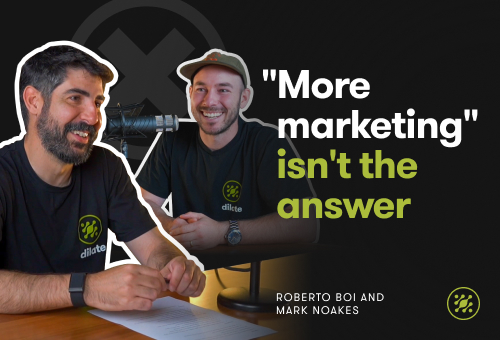
In the newest episode of The better everyday podcast, I sat down with our Director and Head of Strategy, Mark Noakes, about why more marketing isn’t the answer, and what actually needs to change.
The convenience tax we're all paying
When everyone can produce more, faster, the baseline changes. Output increases. Distinctiveness doesn’t. The result is a market full of activity that looks busy, but feels interchangeable. Same formats. Same hooks. Same tactics, recycled at speed.
That’s the convenience tax.
You get efficiency, but you lose difference. Volume replaces momentum, and activity starts to get mistaken for progress.
As Mark put it in our conversation:
“The barrier to entry on doing your own marketing is way lower than it used to be… and the challenge people run into is, if everyone can do this, how do you actually stand out?”
This is where a lot of teams get stuck. Not because they’re falling behind, but because the bar keeps resetting. You end up doing more work just to stand still.
Channel obsession is a symptom (not the disease)
When results dip, channels are the first thing to get blamed.
Meta worked. Now it doesn’t. Google used to convert. Now it’s expensive. Budgets get shifted, agencies get changed, and tactics get reworked. The assumption is that something in the execution must be broken.
Sometimes it is. Often, it isn’t.
Focusing on channels avoids harder questions. Is the message still relevant? Do people actually understand what you do? Have buying conditions changed? Do you know where you’re really winning, or just where the last click happened?
Last-click metrics make everything feel urgent and fixable. But trackable doesn’t always mean understood. Optimising the wrong thing just helps you move faster in the wrong direction.
What actually needs to happen (get some clarity)
This is where progress becomes possible.
Clarity is knowing where you are, what you are trying to achieve, and who you are doing it for. It is understanding how the system works as a whole, not judging performance through a single channel or metric.
Without shared clarity, teams struggle to decide what matters most. Everything feels urgent. Nothing feels certain.
In Mark’s words:
“If you don’t know where you are, how do you know how to get to where you want to go?”
Clarity doesn’t reduce the amount of work required. It improves the quality of that work. And that shift is what creates stability in an otherwise noisy environment.
Why stepping back feels risky (but isn’t)
For most marketing managers, stepping back feels like the riskiest move of all.
You’re under pressure to fix things quickly. Results are visible. Spend is visible. When something dips, the expectation is to act. Doubling a budget or changing a channel often feels safer, politically, than challenging the brief or asking whether the system itself is still right.
Pausing to reassess takes courage. It means saying, “Before we optimise, we need to understand what’s changed”. That’s not an easy conversation to have.
But pushing harder doesn’t fix a broken system.
Optimising faster only helps if you’re pointed in the right direction.
Where this leaves us
Marketing is more demanding than it used to be. The margin for error is smaller, and shortcuts wear out faster.
The businesses that win focus on clarity. They stay consistent in what they say, deliberate in how they show up, and clear about who they are for. Rather than trying to be louder, they work to be understood.
That takes restraint. It takes consistency. And it takes the confidence to pause before pushing harder.
Listen to the full conversation with Mark Noakes to hear how clarity changes what marketing can actually deliver.
View the full podcast transcript below
This transcript has been lightly edited for clarity and readability.
Rob: Welcome to The better everyday podcast, I'm Rob from Dilate, recording from DilateHQ. I'm here with Mark, our Head of Strategy and Director. How are you, Mark?
Mark: Doing good, doing good.
Rob: We're going to talk about marketing, complexity, visibility, clarity, brand, everything about it and we're going to debunk a lot of things.Is marketing complex? Maybe or it's very easy and we're just complicating it… we don't know yet but we'll talk about it soon.
Rob: Let's start from what you think about this: Has marketing changed, is it the same thing, is it more noisy? It's always been complex, but cutting corners worked before and it doesn't work anymore. What do you think, what’s your take on it?
Mark: I think to be honest the barrier to entry on doing your own marketing is way lower than it used to be. You know, you've got AI and that sort of thing. So it's the access point for people to get in and to play around and to understand pieces and is much easier.
Mark: I think with that, the challenge that people are running into is: one, do I trust it? Is it actually correct? And the other thing that they're running into is “well, if everyone can do this,
how do I stand out compared to everybody else?”
Rob: So let's talk about our clients, so looking at SMEs and small businesses. What are they saying to you? What are marketing managers saying to you, and your team of course?
Mark: To be honest, the biggest thing that they're saying is they're just overwhelmed. Right? There's so much noise now and in terms of where they should be learning, what they should be doing, everything is spitting out content. I mean look, here's another piece that we're producing right now. It's another thing which unless it's providing value or is actually communicating something, then it's just another piece of the noise that's out there. So I think that's where people are at… there is so much noise they don't know what to trust.
Rob: And do you also think that because of this noise, the board or the CEOs are asking for more from the same person? Because, “Oh now you have AI, you can do much more,” and then they feel this pressure, and then everything's sort of disconnected. Not to say about the influencers that say, “Oh you can build a website in five minutes with AI or create a campaign like this…” But, let's see what happens if you know what I mean. Are they under extreme pressure now to deliver more because people say it's just easier to do?
Mark: Absolutely. The expectation is that everything can be done super quickly. “Look what I can produce in one second when I told GPT this” or “...when I told Vercel this…”. That sort of thing. Yes, you can do a lot of things quite efficiently, but it's the iteration of stuff to actually refine the work and to get to an outcome that is actually to a standard that is representative of the quality of your brand. That's the challenge that people are running into when they're actually going to implement and actually put it out in the real world. The challenge that they're running into is that the expectation is higher than ever and that you should be able to do it all… “I can do it in five minutes so why can't you do it in five minutes?”
Rob: So, let's talk about challenges that the team are seeing with accounts. Are you guys finding any challenges that you haven't seen before in the past years when it comes to complexity marketing especially due to too much content being produced or ads getting fatigued or even the content not performing as used to?
Mark: Yeah, I think you’re seeing it in the fact that you can produce creative much more efficiently now in a lot of scenarios. So with that, there is a lot more stuff hitting the market too. The ad marketplaces are becoming more competitive. If there's more advertisers, if there's more people bidding, if there's more people playing in the space, it drives up the cost per impression, the cost per click, that sort of stuff. So there are those challenges there where you need to make sure that your clients are consistently performing significantly better than the rest, so that if you're improving and you're increasing your click through rates you're increasing your engagement rates then you're actually going to be trying to maintain the performance that you've been getting a year ago.
Mark: One of the challenges that exists is to be improving what you're doing to actually maintain what you've had in the past. Which sounds a little bit wild because it might not sound like you're growing, but at the end of the day, you need to grow to stay the same. And then you also then need to go beyond that too which is when you start to look at making sure that the clients actually understand who you are so that you can take a stance for the brand and that you can create consistent messaging, consistent tonality. So that when people are actually engaging with the brand they're relating to it more cleanly. They can personally resonate and have emotion or have an emotional response to what you're putting out there, which is again going to improve that engagement, the click through rate, that sort of stuff what you're doing.
Rob: We always get back to brand performance. You know brand versus performance and if you follow us you might have seen John and Luke chatting about this. It’s not brand or performance, it is brand and performance. The most important word is “and” between brand and performance. I think what you just said, it's extremely important. If your brand is not strong and people can't connect to it emotionally, then your performance doesn't really work. It will stop working eventually.
Mark: Yeah exactly, and to be honest what you said about the “stop working eventually” piece is probably key there. Because at the end of the day you can always create some viral hook or content or something like that that might work for a period of time, until it's copied and until it's drowned out. But if it's not representative of your brand, it's not actually going to create a long term impact that is actually going to stick in the minds of your customers. It might just be a quick thing they go, “Oh yeah cool,” and then might purchase from you once and then move on.
Rob: I like that we're going to performance. Let's go back to our roots. Dilate was born as a performance agency… pay per click advertising, search engine optimisation, that was our edge. And then what happened? Because you've been deep, I mean you and I back in our time have been working a lot on that on this channel… having a lot of success. What has changed since then? Why does it work or it doesn't work anymore? And why?
Mark: Depending on the business, depending on where they're at that, it can definitely work in the right circumstances. I think it's when you want to go beyond taking a share of the market that's ready to purchase like who's at the bottom of the funnel. Then you need to go “Okay cool, well what are we doing beyond that? How are we going to start to claim market share from either the big players, or how are we going to start to be an industry leader in the markets that exist?” If you try to just play purely on performance then you’re literally excluding everybody before they even know that they need what you have. So then what's happening is all of your competitors are building relationships with your customers before you even get a chance to talk to them.
Mark: That's what's changed for us and a lot of the stuff that we're doing is we're working with businesses that aren't the small businesses who purely just need a little portion of the market that will sustain their business and keep them going. And we still do work with a few of those who just need a little bit of bottom of the funnel kind of performance marketing. They don't want to grow super aggressively or anything like that and they're happy with the way business is working. But as you become someone who is recognised in the industry and you want to have impact and legacy of a business, you do need to have a brand that resonates with the people, and that is actually communicating and engaging with the audience before they've actually decided what they want.
Rob: What is brand then? Define it.
Mark: I think brand is the way that customers perceive you, right? If I say to you what does someone think of Dilate? I would say that is to me what our brand is.
Rob: I heard a definition once, maybe I can claim it, maybe I said it, I don't remember. But it was summarised very well. Brand is what people think of you when you're not in the room. It's very important because everyone wants to tell you, “you’re great, you’re the best at doing this and that”, but then when they have to purchase, how do they purchase? What are their emotional triggers? What journey do they go through?
Rob: I contradict what you said before about the smaller business, that they just need the bottom of the funnel, yes it works. But let's talk about a tradie. Brand is also Google reviews and its reputation. It could be a one man band. Let’s talk about Joe the plumber in a little town in regional Australia. Everyone trusts him, he does a good job, he charges the right amount.
Mark: It’s actually funny, I literally called a plumber the other day in a regional town.
Rob: Why did you call him?
Mark: I needed to do some laundry taps.
Rob: No sorry, how did you find out about him?
Mark: So to be honest, I got a referral from my buddy.
Rob: Right, that’s brand. Right? Brand is word of mouth. Brand is when people trust you. That’s what I think it is and I know that John is much more academic than I am. But for a very small business, brand is your reputation at the end of the day.
Rob: Now let’s go back to our core clients or marketing managers. Obviously they have so much pressure on performance and that comes probably from the CFO and CEOs. And I think it's caused by the ability to track everything. But tracking everything doesn't mean you actually know what is going on, right? So tell me more about that. How are we helping marketing managers solve these problems?
Mark: That totally depends on the type of business. As you mentioned there, if you are purely looking at last click attribution or something like that now, which is essentially what was the last thing someone did when they purchased from us? So let's say you're looking at the source of that person who inquired and then bought. And let's say they come through organically or from a Google search or something like that. Now if that's the only metric that you're looking at, then it's really hard because you kind of go, “Oh cool, look, all of our sales are coming from organic Google search.” But then the challenge is if all of that organic Google search is actually coming from word of mouth or it's coming from Meta ads that you're running, that is creating an awareness that people are then going back and then searching for you at the time when they're ready to purchase. It is really hard to actually go, “Okay, cool, where are we getting the performance from?”
Rob: So like an orchestrated ecosystem where everything plays their part, right? So you have your emotional brand and some channels here, and then you have your bottom of the funnel, then you have your automations, potential clients or existing clients. And I think the CRM pieces, the technology to use, dashboards as well in general, is helping you.
Rob: So I had some chats with clients and a recurring issue seems like that people are absolutely obsessed with channels. So, “I just want to do ads in Google, it works,” and then “I’ve done this for five years and now it’s stopped working so I changed agencies, but it’s not working. What do I do?” I hear this constantly and they’re so fixated with channels and tactics rather than understanding what’s going on in the market, or is my system right? Do you find these problems with some of the clients there, especially the new ones that we onboard?
Mark: That makes perfect sense and yeah, we do see that a bit. It did work, it needs to work again. That’s the scenario that people are in, and I think the biggest challenge is it doesn’t take in what is going on in the world. Whether it is the world that is their industry ecosystem. Whether it is the world that is beyond that. Whether or not it is the market. Whether or not it is people in that market’s expendable income. All those sorts of things.
Mark: A lot of the time it might be that yes, something’s gone wrong in the channel system or something like that, but the other thing to take into account is if you’re doing that and you are changing it, or you’re reverting back to how it used to be or those sorts of things, and nothing’s moving, then you really probably just need to take a step back and have a look at it as a whole and go “Okay, cool, what are our competitors doing? Has there been a change in the way that customers are buying? Has there been a change in our customers? What’s been happening to average order values?” These sorts of things. Because if you start to look into that entire ecosystem then you can actually start to go “Maybe it’s the way that we’re communicating, we’re no longer resonating with our audience.” Maybe it’s that there might be some financial pressures on your market group and because of that they’re spending less, they’ve got less expendable income. It may be that there’s innovative new products entering the market that are actually much better than what you’ve got or that are much cheaper than what you’ve got. It may actually be something that you need to pivot a little bit.
Mark: Kind of like I was saying before, there might be something that you can do as a viral thing that might get you a lot of reach and that sort of stuff early and work really well, but then it’s not resonating anymore because everyone’s done it and it’s boring. So you can either find the next viral hack that you’re gonna do for it, or you can find out a message that is consistent, that resonates with this audience that we can communicate to actually build a long term strategy.
Mark: So I think in a lot of those scenarios, yes, sometimes something is just broken and you need to make sure you fix it. But in a lot of those scenarios, you actually just need to take that step back and really look at the entire ecosystem and, I guess, what is your brand and marketing strategy?
Rob: Which doesn't mean you can't fix things whilst you do, it is eventually you'll have to just step back and say, “Okay, let me pause for a second. What is going on here?” And I think what you said before, getting the same results, spending the same amount of money means you are growing, because the cost of advertising is higher anyway. The platforms are built for you to spend more. It's a bidding system, there's more people. So if you're getting the same results spending the same budget, you're probably up 20% from last year in terms of advertising performance. Your revenue is not, but you can't just look at your revenue in isolation without understanding how your marketing is performing.
Mark: And to be honest, if you've got a really good product and if you have a really strong brand and if you're spending the same amount and your ads are performing as well as they were the previous year, then your business should still be growing. Because if you've got a good product and if you've got a strong brand, then people in your audience should talk about it as well and there should be an element of growth that comes from that too. Because if you are putting all this money into marketing and you're not actually seeing any growth in brand or you're not seeing any growth in referral or organic and that sort of stuff as well, then if everything else is staying the same, what that's telling you is that your marketing is working but your product is not.
Rob: I did, there’s a case study on Tracksuit, I might put the link in the description, of how Nike stopped investing in brand and just put everything into performance, literally pure performance. I think it was 2020 or 2022. I think they lost a million clients in two years. Because Nike at the end of the day, you buy a pair of shoes because of the emotional connection you have with the brand, the grit. They just do it. Do you know what that means? When I read what it means, I was like I’m just gonna buy these shoes because it was really cool. It has nothing to do with the lead. It has nothing to do with the quality of the shoes.
Mark: It’s just them saying that when you’re up against it, just do it.
Rob: If the day is not going well but you’re still going to wear your shoes and go for a run and it’s raining, we will be there cheering for you, just do it. Then obviously you build that association. Nike has been for years siding with social causes, and I remember recently, I don’t remember the name of the American football player, when they started kneeling for the national anthem. They started with them, they had a short term loss but a long term win was massive, because obviously they had those gains from people.
Rob: And obviously it’s hard to say. People will say “Yeah but it’s Nike, I’m not Nike, I’m just a small business here”. Well what’s your story? Why did you start that business? And I think when you start telling people why something exists and what you do and why you do it, people start buying from you because they connect with you. If I find out that a brand decided to open a factory in Australia and made an investment into the local community and keeps the community alive and the product is great, I will buy from them. I’ll spend a bit more but I will buy from them. As opposed to someone dropshipping an Alibaba product. Great. “Why do you do it?” “I just want to make money.” Good, but that’s no mission. There’s no reason why I should buy from you. It’s a clear transactional type of marketing, which works, don’t get me wrong, but that’s not the customer I want to connect with.
Mark: Well, that’s exactly it. You take a stand as a brand. It doesn’t necessarily mean I now have all of the market, that’s not how it works and it’s not how it should work. If you stand for things, if you represent things, then that will resonate with a specific part of the audience and those will be the people who become your loyal fans and who will purchase from you over and over. Whereas if you stand for nothing, you might be able to convince people to purchase and you might be able to get a good return on your ad spend, but again if there is nothing in it, why are they going to keep coming back? They’re going to find someone else who is dropshipping it for one dollar cheaper than you. Why are they going to buy from you now? They’re not. They’re going to buy from them because there is absolutely no loyalty if you’re purely transactional.
Rob: So if tactics aren’t the problem of marketing, what is missing? What should brands do? We talk about marketing strategies, is there anything else that you think they should be doing? We talk about a lot of things, but let’s say someone comes here and says “what do I do? Where do I start from? How long is it going to take?” What would you say to someone?
Mark: I’d say “how long is what going to take? What is it you want to achieve?” To be honest, if you don’t know that, you shouldn’t go any further. If you don’t have a goal, if you don’t have something that you’re trying to achieve, then you really can’t say how to do it. Because a lot of people might come in and they might say “Hey, how do I do this?” We might say well look, to be honest, what you want to achieve actually doesn’t require us and that’s good, because you can go and do X, Y, Z and you can achieve that.
Mark: At the same time, if someone comes in and they say “Look, I want to book more plumbing jobs in my local suburb”, then to be honest my first step would be okay, if that’s all you want to do and you don’t have serious ambitions to grow the team and create a franchise structure or something like that, not to say that you need to go that big, but if they just want to pick up a few more jobs and put a bit more food on the table, maybe just start getting some magnets and stick them on some mailboxes.
Rob: Or Facebook community groups and just put “Hey, this is what I do and this is who I am.” That works. You don’t have to have something massive, but it takes time and patience is important.
Rob: In the same way, if you want to get healthy and go to the gym, it takes time. It takes months.
Mark: You don’t just do sit ups in the morning and push ups at the end of the day and you’re jacked. That’s not how it works.
Rob: You need to eat well. You need to go to the gym. You need to be consistent. You need to just do it. You need to take some supplements. There are a lot of things that might influence what you do. Drink less, possibly no smoking. There are a lot of things that influence everything. And obviously you start with, if you want to lose weight, that’s the first question they ask. What’s your goal? Do you want to lose weight? Do you want to put on muscle mass? What do you want? Based on that, they’re going to tell you a plan, and that’s exactly what we do.
Mark: Some people might want to put on muscle weight or something like that too. So the approach that you take is going to be entirely dependent on what it is that you want to do.
Rob: When we say to people it might take some time, do you think the industry makes marketing and journeys and funnels and tactics more complicated than they actually are?
Mark: Yeah.
Rob: Do we do it too, by the way?
Mark: At the end of the day, to be fair, the logic of it is simple. The execution of it isn’t as simple. I know that sounds ridiculous, but I think sometimes, and even we do it, we overcomplicate it. We might sometimes get a little bit too caught up in the nuance of how deep we go into our customer journeys and those sorts of things. But at the end of the day, if you are matching things correctly, then it is actually quite simple. If you know what you’re going to do and you know why you’re going to do it and you know who you’re going to do it for, then you should be able to say this is how I do it.
Mark: That is a vast oversimplification in the other direction now, but essentially yes, it is. Because there are so many different ways of structuring that, whether it’s buyer personas, whether it’s audience personas, whether it’s ideal customer profiles, there are so many different ways of doing the same thing. I think it does become very confusing because each person comes and they say you do it this way, no you do it this way. But as long as you are doing those steps, then you should be okay.
Rob: I follow a guy from an agency in San Francisco called Client Boost. Patrick Ham is the CEO. Great guy. I’ve been following him for probably 12 or 15 years. He says quite clearly it’s very easy. Ninety five percent of people are off market, five percent are in market. How do you move them in market? Then we can look at all the final stages and everything and the complexity of it. But at the end of the day, move those people in market. How? Just give them content that answers their pain points and give them confidence that you are the right person to work with. Simple. There are obviously a lot of things we do in between, content production and a lot of things that are very important, but as you said, we can always simplify that.
Rob: I also think when I used to work client side, all the buyer personas and ideal customer profiles, when you work especially in brick and mortar, you get to know people and talk to people. You automatically know what your buyer personas are and what their pain points are. So there’s no need to use marketing terminology. You can just say to a client hey, can you provide the customer. When I was working in a sports centre, I knew the decision makers. I knew that until a kid is 12 or 13, the parents are making the decisions. So I knew what the pain points were for those parents. After that, when the kids are 14, they become my clients. How do I convince them to stay and play the same sport? Then you have the adults, then the masters, then the older people.
Rob: I didn’t know a lot of the terminology back then, but when I started working with buyer personas and ICPs and everything, I was like oh yeah, everything makes sense. I would name that person. They all looked like Penny. Penny was my ideal mum client. So it’s very simple, but we overcomplicate things.
Rob: One quick thing from complicated things, let’s talk about clarity. I like that you talk about goals. How hard is it to pick a goal for your business? Because when I speak to businesses, they’re like what’s your goal? “I want to fix my ads.” That’s not a goal. That’s a short term problem you have. How hard is it to find a goal, and do you think some customers need help to actually decipher what they want to achieve?
Mark: Yeah, I think so. Or just even to define it. Sometimes it’s just general or vague, like grow. If your overall goal is we want to grow, it’s really hard because you can’t put figures against it and say in order to do this we need to do this. If it’s general and vague, you can do a bunch of general vague things. So sometimes just to define it or agree on those things and work together to do that is important.
Rob: You’ve probably sat in a brand strategy workshop before with the workshops that we do. I find it fascinating how it takes a lot of time for people to actually get into those things.
Mark: A lot of people don’t spend the time doing it. Fair enough, they’re in the day to day of the work, so they haven’t necessarily been able to take that step back and say okay cool, I’m actually going to spend some time thinking about what it is that we want to achieve and what an ideal outcome looks like. The second people can start to say this is what that looks like, that’s when things change. But if you’re in the weeds doing the work, sometimes you’re just not taking that step back.
Rob: When we implement something for clients, what do you think most campaigns don’t have clarity on? Is it an end goal? Is it the people we’re targeting? What is one of the most common lack of clarity signs?
Mark: To be honest, I think a lot of the time it’s visibility. You can’t have clarity without visibility. You might say I have clarity on what I want to achieve, but you’ve got no idea where you are. If you don’t know where you are, how do you go from A to B if you know B is here but you don’t know where you’re starting from? Maybe you’re on the other side of it already.
Rob: At what point does fixing performance require stepping back instead of doubling down? It’s a very common problem. Just throw money at it. Let’s up the budgets. I’m doubling the budgets but I’m fifty percent down. When does it actually require us saying hey, we’re going to stop and step back?
Mark: That’s a really good question. When do you need to step back? It depends how technical you are. From my perspective, the first thing you need to do is a proper audit of what’s going on and then review it. Compare it to what was working in the past and say okay cool, what’s the difference? A lot of the time you’ll find out has there been a change. Is it different search terms being triggered? Is it structured differently? Then you can say there’s actually a fundamental change between how things are structured now versus how they were structured. If that’s the case, you may need to revert back, have a look at how things were, see if that stabilises and then start to re optimise from there.
Mark: If you look at it and everything is structured well, set up well, targeting the right things, targeting the right people, you’ve got the right messaging, the same messaging as when things were working before, then you might need to say okay, this isn’t a structure thing. This isn’t just that something has stopped working and I’ve broken something. Now we need to take a step back.
Rob: I don’t know if I can say this in a podcast. Do you think marketing managers have enough [courage] to stop and tell the CEO we need to step back and look at this? Or even us as an agency. Are we brave enough to tell a client to stop what you’re doing, at the cost of losing the client? Because that’s happened before.
Mark: Unless you’ve got the right person there to do it or someone confident enough, that is a huge challenge. If you are in a bigger business where it is a marketing manager and things aren’t going well and the owner is telling them you need to fix it, and they’re sitting there thinking there’s nothing wrong with this, we need to fix the business or take a wider look at things, that is a very hard thing to do.
Rob: How do we help them convey that message? Because I think that’s where people get lost. They think that’s what they’re asking me to do, so I’m going to do it. We have values as a company. We will stop it because we like accountability and transparency. But would a marketing manager do it or just pump more money in and try to show it’s wrong? I don’t think that’s the right approach. The goal for me eventually is that we are able to help this marketing manager convey the message or have that conversation that will help the business grow in the long term, with short term fixes but a long term strategy.
Mark: A huge part of it is the way that you communicate it and how receptive the person you’re speaking to is.
Rob: Knowledge is power. You need the clarity to be able to do that and you need to be able to show that. That’s why knowing how the ecosystem works and having the right reporting and visibility and dashboards will help you show that just pouring your money into a black hole sometimes doesn’t lead to good results.
Rob: Let’s go to the end of this chat. If businesses and brands keep doing what they’re doing now, where does it lead?
Mark: Nowhere. Everything becomes more expensive for everybody. If we do nothing differently, it will stay the same but become more expensive.
Rob: It is unfortunately true that doing the same thing doesn’t work. Your customers want more. They need more from you to understand who you are, why you do it and what the benefits of your products are.
Rob: As an agency as well, we have changed a lot in our marketing. We’re going through this process of redoing our brand strategy, refining it and redoing our marketing strategy. It’s been quite refreshing to see that even though for us we always say you have fifty marketers here and everyone knows better, so it’s always very hard to run a marketing strategy, having the marketing team actually set a goal that is a smart goal, achievable and tangible, and getting that clarity to then have the foundation to drive growth is probably the secret.
Rob: If you keep doing what you’re doing, that leads nowhere.
Rob: Anyway guys, we’ll see you next time and thank you so much for listening to this podcast. Subscribe to our LinkedIn newsletter and see you next time. Thanks Mark.
Mark: Thanks guys.